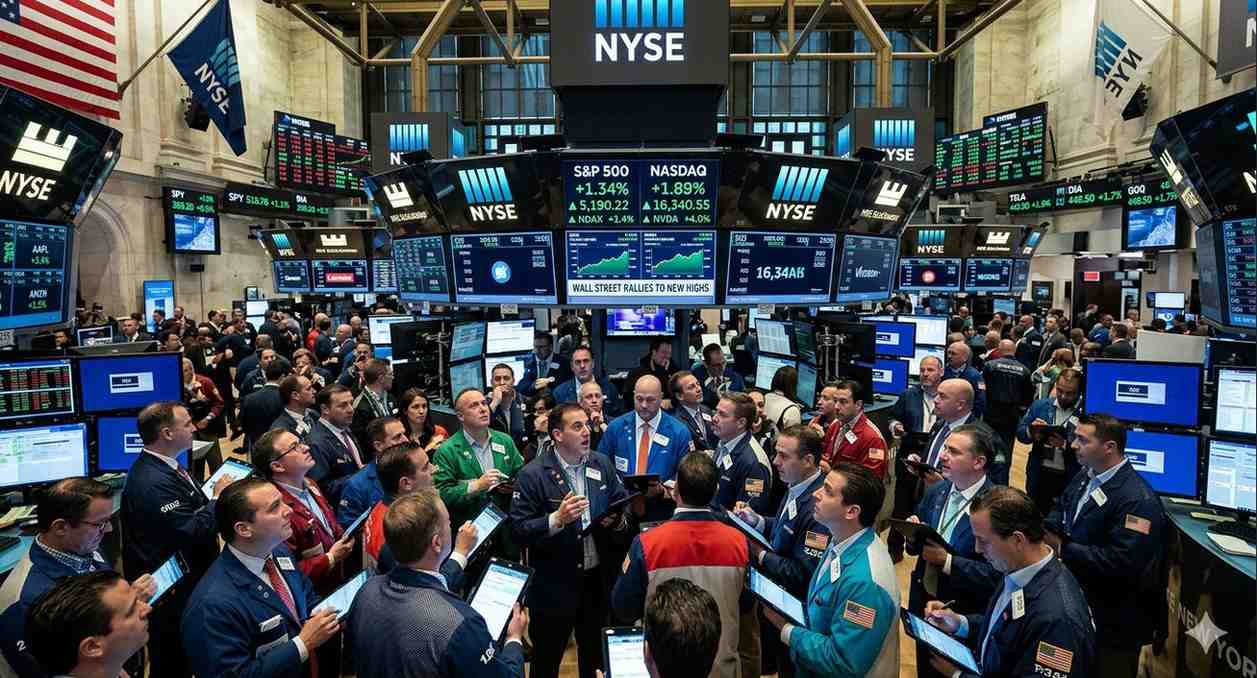
Wall Street turned higher during a volatile Thursday session, driven by a major geopolitical breakthrough and highly anticipated inflation data.
Stocks spiked following an Axios report stating that Washington and Tehran have reached a memorandum of understanding on a peace deal, which now awaits final approval from President Donald Trump. The news injected optimism into a market that had opened flat due to early-morning military strikes between the U.S. and Iran and inline inflation figures.
By 11:20 ET (15:20 GMT), both the S&P 500 and the NASDAQ Composite had notched new intraday record highs:
- S&P 500: Up 0.4% to 7,549.79
- NASDAQ Composite: Up 0.5% to 26,803.22
- Dow Jones Industrial Average: Flat at 50,632.49
Inflation Data Matches Estimates as Fed’s Preferred Gauge Climbs
During a holiday-shortened week dominated by Middle East developments, Thursday’s attention shifted toward a heavy U.S. economic calendar—specifically the Federal Reserve’s preferred inflation metrics.
According to the U.S. Bureau of Economic Analysis, the core personal consumption expenditures (PCE) price index, which excludes volatile food and energy costs, rose 3.3% year-over-year in April. While this represents the highest level since November 2023 and remains well above the Fed’s 2% target, the figure perfectly matched consensus estimates. Meanwhile, headline PCE ticked up to 3.8% year-over-year, marking its highest reading since May 2023, though it also landed exactly in line with Wall Street expectations.
On a month-over-month basis, core PCE eased to a 0.2% increase in April, down from March’s 0.3% reading and coming in cooler than the projected 0.3% estimate.
This deceleration arrives at a critical time for the economy. Surging oil prices triggered by the ongoing conflict with Iran have heavily pressured both American consumer and producer prices. In fact, retail gasoline prices have spiked by more than 50% since the conflict began in late February, according to data from the U.S. Energy Information Administration (EIA).
U.S.-Iran Move Toward Historic 60-Day Peace Accord, Awaiting Trump’s Decision
Turning to the Middle East, a major diplomatic breakthrough may be on the horizon. Axios reports that the U.S. and Iran have reached a 60-day memorandum of understanding (MoU), citing two U.S. officials. The agreement would extend the current ceasefire between the warring nations and officially kick off negotiations regarding Tehran’s nuclear program.
According to one official, President Donald Trump has been fully briefed on the final details and has requested a few days to review the terms before giving his final approval.
Key Terms of the MoU:
- Maritime Freedom: Guarantees “unrestricted” shipping through the highly critical Strait of Hormuz.
- Lifting the Blockade: End of the ongoing U.S. naval blockade of Iran’s ports and coastline.
- Nuclear Commitment: A formal pledge from Iran to halt its pursuit of a nuclear weapon.
If signed, this agreement would mark the most significant breakthrough in a conflict that has raged since late February, when a joint U.S.-Israeli assault on Iran ignited the hostilities. The warring parties have been locked in a protracted ceasefire since early April while diplomats hammered out the details.
Here are a few ways to rewrite this section, depending on the format and tone you prefer:
Option 1: Clean & Professional (Best for financial reports or market updates)
Crude Off Highs After Peace Reports Defuse Gulf Escalation
Oil prices sharply pared their gains following the Axios report. Brent crude futures for August delivery, the global benchmark, were last up 1% at $93.18 a barrel, reversing a sharp 4% rally that had pushed prices as high as $95.97 earlier in the session.
Prior to the peace deal news, hopes for an accord had taken a hit following a fresh exchange of military fire in the Persian Gulf. According to U.S. Central Command (CENTCOM), Iran launched a ballistic missile toward Kuwait late Wednesday, which was successfully intercepted by Kuwaiti forces. CENTCOM labeled the incident an “egregious ceasefire violation,” noting it occurred just hours after Iranian forces deployed five attack drones near the strategic Strait of Hormuz. All five drones were intercepted by U.S. forces, who also neutralized a sixth drone launch site in Bandar Abbas.
In response, Iranian state media reported that its armed forces had fired warning shots at four vessels attempting to navigate the strait without navy supervision, forcing them to turn back. State television also broadcast footage of the Islamic Revolutionary Guard Corps (IRGC) retaliating against the strike on Bandar Abbas.
This military friction escalated shortly after President Trump dismissed a separate report suggesting Iran and Oman would jointly manage shipping through the strait under a peace agreement. Trump aggressively rejected the premise, stating, “Oman will behave just like everybody else or we’ll have to blow them up.” While the president indicated that Tehran was eager to negotiate, he made it clear he was not yet satisfied with the terms on the table.
Wall Street coming off record close
Wall Street’s main indexes closed modestly higher on Wednesday as market participants held onto hopes that a peace agreement to end the war in Iran could be finalized in the coming days. However, some of that optimism was held in check after the White House dismissed a draft Memorandum of Understanding broadcast by Iranian state media, calling it a “complete fabrication”.
According to analysts at Vital Knowledge, equities found support in a pullback of global oil benchmark Brent crude. Combined with solid earnings reports from Abercrombie & Fitch and Bath & Body Works, alongside reassuring economic commentary from a closely watched industry conference, the news helped trigger significant gains across consumer discretionary stocks. Conversely, energy stocks faced downward pressure, and investors locked in profits on recent high-flying technology names.
Investors are biding their time regarding the Middle East and, despite the resurgence of attacks, continue to hope for a constructive outcome to negotiations between the U.S. and Iran,” noted Andreas Lipkow, chief market analyst at CMC Markets. “However, this is causing trading volume to thin out and price volatility to decline.